
Introduction
In complex pharmaceutical manufacturing facilities, material transfer isn’t always a simple straight line between two rooms. Often, a single material transfer station must serve three intersecting zones—for instance, connecting an unclassified airlock/corridor, a Grade C preparation suite, and a Grade B processing room simultaneously.
Installing two separate two-door pass boxes in such layouts wastes valuable wall space, increases HVAC air leakage risks, and creates operational bottlenecks.
By integrating Three-Way Static Pass Boxes or 3-Way Dynamic Pass Boxes, facility architects can streamline material workflows while preserving critical differential pressure cascades.
1. What Is a 3-Way Pass Box and How Does It Work?
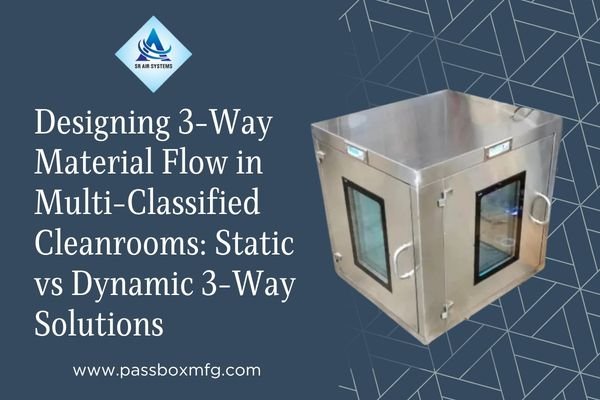
A 3-Way Cleanroom Pass Box (configured in an L-shape, T-shape, or triangular housing) features three independent doors opening into three separate cleanroom environments.
To maintain cleanroom classification integrity, the unit utilizes a tri-door electronic/electromagnetic interlocking logic matrix.
+-------------------------------------------------------------------------------+
|                       TRI-DOOR INTERLOCKING LOGIC STATE                       |
+-------------------+--------------------+--------------------+-----------------+
| Door Action       | Door A (Corridor)  | Door B (Grade C)   | Door C (Grade B)|
+-------------------+--------------------+--------------------+-----------------+
| Operator Opens A  | OPEN               | LOCKED             | LOCKED          |
| Operator Opens B  | LOCKED             | OPEN               | LOCKED          |
| Operator Opens C  | LOCKED             | LOCKED             | OPEN            |
+-------------------+--------------------+--------------------+-----------------+
Key Rule: Under no circumstances can two doors open at the same time. Opening any single door automatically triggers electromagnetic lockouts on the other two doors, backed by visual LED indicators and audio alarms.
2. Three-Way Static vs Three-Way Dynamic: Selecting the Right Configuration
A. Three-Way Static Pass Box (Passive Transfer)
- Best Used For: Connecting three rooms that share the same ISO cleanliness grade (e.g., Grade C Preparation, Grade C Holding, and Grade C Equipment Wash).
- Airflow Handling: No active filtration. It relies on ambient room pressure and mechanical door sealing gaskets to maintain zone separation.
B. 3-Way Dynamic Pass Box (Active Containment)
- Best Used For: Connecting zones with differing cleanliness classes (e.g., Unclassified Air Sensor Airlock → Grade C → Grade B).
-
Airflow Handling: Features a top-mounted or side-mounted centrifugal blower, pre-filter, and HEPA filter (99.997% at 0.3 micron). It maintains an internal ISO Class 5 vertical downflow ( 0.45 m/s ± 20% ) to purge airborne particles whenever materials are introduced from lower-grade areas.
3. Key Architectural Benefits of 3-Way Material Transfer Stations
- Floor Space Optimization: Replaces two standard 2-door pass boxes with a single compact, wall-flush module, saving high-cost cleanroom wall paneling.
- Reduced HVAC Load: Minimizes cleanroom wall penetrations, helping maintain stable room differential pressures (Δ P) across adjacent suites.
- Optimized Cross-Departmental Workflows: Allows central QA/QC testing or sampling teams to receive materials from two different production lines through one centralized transfer hub.
Optimize Your Cleanroom Layout with Custom 3-Way Pass Boxes
Planning a new facility or upgrading your cleanroom material handling infrastructure? SR Air System (Pass Box MFG) custom-manufactures 3-Way Static and Dynamic Pass Boxes in high-grade SS 304 and SS 316L stainless steel. Our units feature programmable PLC interlocking matrices, flush glass doors, and certified HEPA filtration built to meet international USFDA and EU-GMP cleanroom standards.
Need engineering drawings or a customized quote for your facility layout?
Speak directly to our cleanroom design engineers at +91-7984145193 or email us at info@passboxmfg.com.