
Introduction
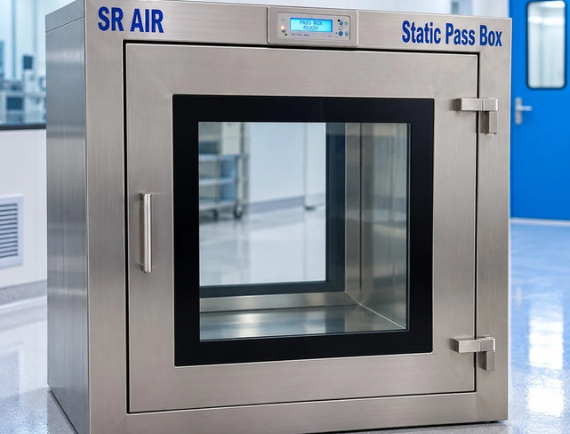
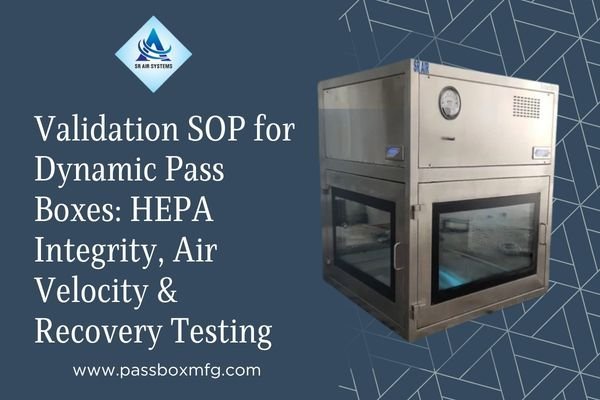
Deploying a Pharmaceutical Dynamic Pass Box is essential for maintaining Class A / ISO 5 air purity during material transfer between cleanroom suites. However, dynamic pass boxes are active ventilation units subject to mechanical wear, HEPA filter clogging, and gasket deterioration over time.
Without routine validation, declining airflow velocity or microscopic HEPA leaks can introduce contaminants into high-grade cleanroom zones, leading to costly FDA Form 483 observations or batch rejections.
To ensure continuous compliance with ISO 14644-1 and EU-GMP Annex 1 guidelines, cleanroom engineering teams must execute three core operational qualification tests annually.
1. PAO/DOP HEPA Filter Integrity Testing (Leak Testing)
The HEPA filter inside a dynamic pass box traps 99.997% of airborne particles down to 0.3 microns. Over time, filter media pinholes or degraded gel seals allow unfiltered air bypass.
Execution Protocol:
- Aerosol Generation: Introduce Polyalphaolefin (PAO) or Dioctyl Phthalate (DOP) aerosol upstream into the dynamic pass box blower inlet at a concentration of 10 to 20 micrograms per liter.
- Upstream Verification: Measure the challenge aerosol concentration using a calibrated aerosol photometer.
- Downstream Scanning: Slowly scan the entire downstream face of the HEPA filter and its perimeter mounting frame using a photometer probe held approximately 2.5 cm from the filter media.
Acceptance Criteria: Any downstream aerosol penetration exceeding 0.01% of the upstream concentration is considered a leak requiring immediate filter re-sealing or replacement.
2. Downflow Air Velocity & Uniformity Balancing
To ensure airborne particles are swept away rapidly during material transfer, the internal centrifugal blower must maintain a uniform vertical laminar airflow pattern.
+-------------------------------------------------------------------------------+
|                      AIRFLOW VELOCITY VALIDATION GRID                         |
+-------------------------------------------------------------------------------+
|  [ Point 1 ]           [ Point 2 ]           [ Point 3 ]                      |
|  Top Left              Top Center            Top Right                        |
|                                                                               |
|  [ Point 4 ]           [ Point 5 ]           [ Point 6 ]                      |
|  Center Left           Center Point          Center Right                     |
+-------------------------------------------------------------------------------+
Execution Protocol:
- Position a calibrated vane anemometer or thermal anemometer 150 mm (6 inches) below the discharge grill of the terminal HEPA filter.
- Record velocity readings across a minimum of 5 grid points (four corners and one center point).
- Calculate the average airflow velocity across all grid points.
Acceptance Criteria: The average vertical airflow velocity must remain strictly within 0.45 m/s ± 20% (90 fpm ± 20%), with individual grid point variations not exceeding ±20% of the average.
3. Cleanliness Recovery Time Test (100:1 Recovery)
The recovery test evaluates how fast the dynamic pass box internal chamber purges airborne contamination after an operator opens a door to insert materials.
Execution Protocol:
- Generate an artificial particulate cloud inside the closed pass box chamber using an aerosol generator until particle counts exceed ISO Class 7 concentrations.
- Engage the dynamic pass box blower and start an electronic particle counter sampling air inside the chamber.
- Measure the exact elapsed time required for the chamber air to return to baseline ISO Class 5 (Class 100) cleanliness limits.
Acceptance Criteria: The dynamic pass box must achieve a 100-fold reduction in airborne particle concentration within less than 60 seconds (typically between 15 to 45 seconds for high-performance units).
4. Maintenance Checklist for Magnehelic Gauges & Solenoids
Along with annual airflow testing, routine quarterly checks must be logged:
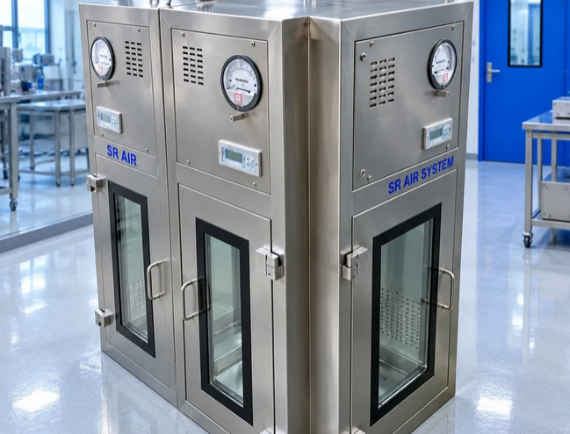
- Magnehelic Differential Pressure Gauge: Calibrate to ensure zero-point alignment. Gauge readings should reflect differential pressure across the HEPA filter (typically 10 to 25 mm WG under clean conditions).
- Electromagnetic Interlock Alignment: Test door solenoids to ensure instantaneous interlocking upon opening either door.
- UV Germicidal Lamp Intensity: Measure UV-C intensity (254 nm ) using a UV radiometer; replace UV tubes when output drops below 40 muW/cm2.
Keep Your Facility Compliant with Certified Pass Boxes
Avoid audit delays and maintain peak contamination control with precision-built equipment from SR Air System (Pass Box MFG). We design and build custom SS 304 and SS 316L Dynamic Pass Boxes equipped with differential pressure gauges, DOP test ports, dynamic airflow balancing, and certified HEPA filtration built to meet USFDA, EU-GMP, and ISO 14644 standards.
Need fully documented, audit-ready material transfer equipment or validation assistance?
Call our cleanroom validation engineers at +91-7984145193 or email your requirements to info@passboxmfg.com.
