Introduction
In aseptic pharmaceutical manufacturing—such as sterile liquid filling, bioprocess suite transfers, and cell therapy production—manual wipe-down using 70% IPA or liquid sporicides carries inherent risk of human error. To achieve absolute sterility assurance levels (SAL 10-6), modern cleanrooms are transitioning from conventional UV-C transfer hatches to Vaporized Hydrogen Peroxide (VHP) Integrated Dynamic Pass Boxes.
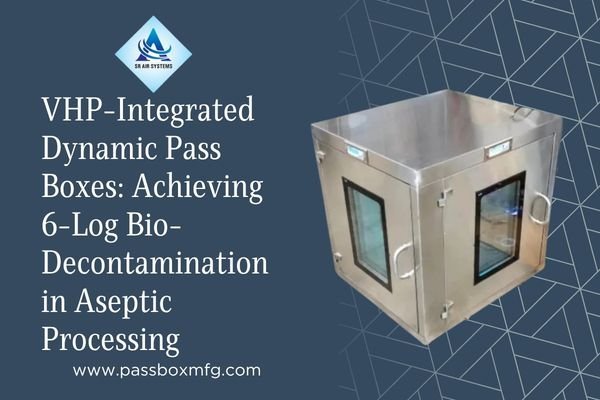
By combining active HEPA-filtered vertical laminar airflow with automated dry-vapor hydrogen peroxide gas injection, VHP pass boxes deliver a repeatable, validated 6-log sporicidal reduction (99.9999% kill rate of Geobacillus stearothermophilus spores) on all material surfaces prior to cleanroom entry.
1. The 4-Phase VHP Decontamination Cycle
An automated VHP dynamic pass box executes a closed-loop decontamination program controlled by an onboard Programmable Logic Controller (PLC) and Human-Machine Interface (HMI):
+-------------------------------------------------------------------------------+
|                      4-PHASE VHP DECONTAMINATION SEQUENCE                     |
+--------------------------+----------------------------------------------------+
| Cycle Phase              | Operational Dynamics                               |
+--------------------------+----------------------------------------------------+
| 1. Dehumidification      | Lowers chamber relative humidity (%RH) to 20-30%   |
| 2. VHP Conditioning      | Injects H2O2 gas at controlled mg/L concentration  |
| 3. Bio-Decontamination   | Holds gas contact time for 6-log sporicidal kill    |
| 4. Aeration & Catalytic  | Catalyst breaks down H2O2 gas to H2O & O2 (<1 ppm) |
+--------------------------+----------------------------------------------------+
- Dehumidification Phase: Internal blowers circulate chamber air through a desiccant dryer to reduce relative humidity. Lowering %RH prevents premature condensation when hydrogen peroxide gas is introduced.
- Conditioning / Injection Phase: Liquid 35% H2O2 is vaporized into dry gas and injected into the chamber until gas concentration reaches optimal target levels ( 400-1200 ppm).
- Bio-Decontamination (Dwell) Phase: The VHP gas concentration is held steady for a pre-validated exposure time (typically 15-30 minutes ), penetrating all surface crevices of transferred tools, vials, or packaging components.
- Aeration Phase: Internal blowers divert chamber air through a catalytic converter (copper/manganese oxide) that rapidly breaks down H2O2 vapor into harmless water vapor (H2O) and oxygen (O2). Aeration continues until internal gas levels fall safely below the short-term exposure limit (STEL < 1.0 ppm ).
2. Essential Construction Requirements for VHP Compatibility
Because vaporized hydrogen peroxide is a powerful oxidizing agent, standard cleanroom equipment components will degrade rapidly if not specifically engineered for VHP resistance:
- SS 316L Stainless Steel Housing: Chamber walls, ceiling plenums, and doors must be fabricated from mirror-polished SS 316L to prevent chemical oxidation and surface pitting.
- Inflatable Pneumatic Door Gaskets: Standard mechanical rubber seals allow gas leakage. VHP pass boxes utilize compressed-air inflatable silicon gaskets that expand against the door frame to guarantee an airtight seal during pressurization.
- Isolated Electrical & Solenoid Housing: All internal electronics, LED lighting, and electromagnetic interlock solenoids must be potted or housed in sealed IP65/IP66 enclosures to prevent circuit corrosion.
3. Regulatory Validation (DQ/IQ/OQ/PQ) for VHP Systems
To comply with EU-GMP Annex 1 and USFDA aseptic processing guidelines, validation dossiers must document:
- Biological Indicator (BI) Challenge: Placing 6 -log Geobacillus stearothermophilus BI strips in hard-to-reach chamber locations (corners, door seams, under material trays) to verify complete sterilization.
- Chemical Indicator (CI) Verification: Visual color-change verification confirming uniform gas distribution throughout the chamber.
- Gas Leakage Safety Testing: Ambient sensors mounted outside the pass box must confirm zero gas leakage (< 0.5 ppm) into operator working areas during the exposure cycle.
Upgrade Your Aseptic Material Transfer with VHP Technology
Protect your sterile core and eliminate manual decontamination variability with custom-built equipment from SR Air System (Pass Box MFG). We design and manufacture SS 316L VHP-Integrated Dynamic Pass Boxes equipped with inflatable door gaskets, PLC/HMI automated cycle controls, catalytic aeration blowers, and certified HEPA filtration built to meet international USFDA, EU-GMP Annex 1, and ISO 14644 standards.
Need a custom VHP pass box specification or technical drawing for your sterile suite?
Speak directly to our aseptic containment engineers at +91-7984145193 or email your requirements to info@passboxmfg.com.
